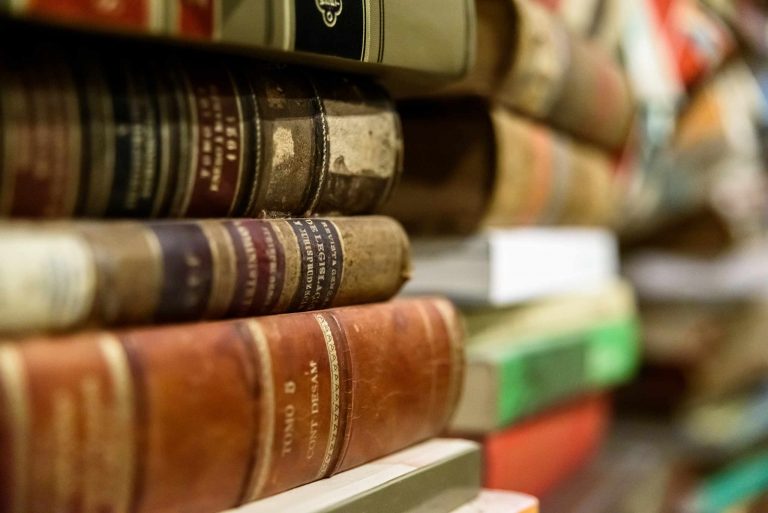

Imagine you have placed a closed hardcover book on a desk in front of you, and imagine you have no prior knowledge of what a book is. What you see may be boards on the front and back, and on the spine you will see the part that joins the leaves together. In between those is the text block. While those words seem self-explanatory, knowing which part is which is key to knowing how to talk about a book.
If you open up the front cover of the book, you should see some kind of connection between the cover and the text block. This is often where the endpapers live: leaves that are glued to both the inside of the boards and the first or last gathering of the book. Go further in and you may hit a half title, title page, copyright page, or other front matter. Rather than thinking of all the stuff before chapter 1 as irrelevant front matter, try to learn which part is which, since it may offer insights into the structure and production of the book.
Take a book off your shelf and explore it. As you go through it, point out the front board, the back board, the spine, the text block, endpapers, title page, etc., while saying the name of the part. Once you have done that, close the book and say those terms again from memory. If your book has a dust jacket, note that the jacket is not the same thing as the book’s binding. It is easy for a beginner to think of all those things as just the book’s “cover,” but using more specific terminology helps you know what to talk about later.
Once you have located the parts of the outside of the book, turn your attention to the text block. If a single sheet is folded inside of a book, it creates leaves, which each have a recto and a verso. In many traditionally made books, there are multiple sheets that are folded, then put together as a gathering in the text block. Occasionally, you may see a signature, which is a number or letter used to designate a gathering. Some books make this kind of analysis difficult or impossible, so don’t force the issue if you can’t tell.
Another benefit to knowing the parts of a book is being able to compare different copies of the same book. Even if two copies are printed from the same type form, or from the same edition, they can still have completely different bindings. One might have different endpapers, a rebacked spine, or even boards with a different covering. None of those differences mean you’re looking at a different edition or printing, but keeping track of what kind of structure a book has can help you distinguish copy-specific features from book-specific ones.
Next time you pick up a book, put aside any questions about its age, rarity, or value. Look at how it was made, from the boards to the text block to the first few pages. Once you know how to distinguish one part from another, your job as an examiner has already started.